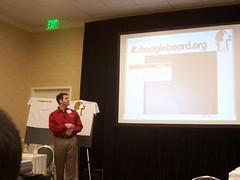
I've mostly given up on trying to be relatively anonymous on this blog. I figure that people who know me already know how to find this site, but I'm starting to try to take on some relatively public responsibilities related to open source software and the newly "announced" BeagleBoard.
Actually, the BeagleBoard isn't officially "announced". The reason is that there really isn't a community or set of applications around it yet to make it something worth announcing. Instead, it is just an open project looking for some of the right folks to help make it happen.
I have a lot of confidence that the BeagleBoard will be a very real and active community project. Just let me know if and how you'd like to get involved.
For those who have read my blog posts in the past, rest assured that the BeagleBoard is quite intertwined with my vision for collaboration. My hope is that it will yield a nice starting point for building collaboration software that could be integrated into just about any form-factor and innovative human interface.
2008-03-05

2008-02-06
Heading to LugRadio Live
You almost can't call it a business trip, but I will be filing an expense report...
Go to LugRadio Live USA 2008, 12-13 April, San Francisco! Watch this, then spread the word!
2008-01-29
Could Pandora open up Linux games?
They say the Open Pandora (P&|A) handheld gaming device compares in power to a Nintendo GameCube, and will offer full-speed Playstation and N64 emulation. How does the GameCube compare to other systems/CPUs?
Of course, what I think is really interesting about this device is it being a clam shell (to protect the screen), having real gaming controls, and being fully open for hacking. I expect a lot of nice software will come out of this device existing.
read more | digg story
2008-01-24
Hello? Jabber was designed for cloud computing
I just read Marshall Kirkpatrick's Read/Write Web post Could Instant Messaging (XMPP) Power the Future of Online Communication?. Despite his apparent bemusement with the "the rise of XMPP (called Jabber in IM) for powering communication services hosted in the cloud" this really shouldn't be much of a surprise. In one of my favorite books of all time, Peer-to-Peer, Jeremie Miller, inventor of Jabber, explained this to the world in 2001. Jabber was envisioned from its beginnings in 1998 to not just handle person-to-person conversations, but also person-to-application and application-to-application conversations.
I also recently read about using Jabber with my OLPC XO-1, which opened up a whole new world. All of a sudden, instead of just finding other XO's on my LAN, my screen was full of people to chat and collaborate with. Over Jabber, not just instant messages are shared from the XO, but every application can be shared and becomes a gathering place. You can take a look at how Jabber is used with the XO on the OLPC wiki.
Marshall goes on in his analysis to bring us back down to Earth regarding Jabber/XMPP relative to HTTP and he is right. HTTP rules today and I don't think there is any one killer reason to change that. If nothing else, however, Jabber/XMPP has a really nice specification on how to use HTTP more efficiently to get notifications without polling. Jabber/XMPP specifies this for the purpose of overcoming firewalls, but the result is that Jabber/XMPP can really be seen as simply some really cool stuff to do on top of HTTP.
2008-01-23
Where is the Jazelle-RCT open source solution?
Ugh. There is too much noise around open source virtual machines, including almost 16,000 projects on SourceForge.
The PhoneME, Android, or other open source JavaVM projects must be looking to support ARM's Jazelle-RCT technology, right? I know there are some interesting commercial efforts, but if anyone is aware of an on-going open source project, I'd want to hear about it.
2008-01-10
Bug Labs device was cooler than I expected
At CES this week, I managed to stop by the Bug Labs demo, which ended up winning an award for the best emerging technology. I've been hearing about this device for months from co-workers and I'd explored the website, but seeing the live demo was more impressive than I expected.
The little Lego-like embedded electronics development kit was quite flexible. As a challenge, in 8 minutes, they created a new application of a motion-triggered camera that would upload photos to a server. I was quite impressed.
They use Eclipse to create an easy-to-use development front-end and PhoneME to run Java applications on the device. The device is running both X11 with Athena Widgets (AWT) and Qt/Embedded. This isn't quite as nice as the GTK stuff running on the N810, but it shouldn't take them any time to get there. The demonstrator had no trouble throwing together a new program in Java and sending it down to the device over USB, despite being harassed by one of his co-workers about the missing award they had just won.
Apparently, someone decided to take their newly won prize. Hopefully, it was just on loan to one of the many television interviewers showering attention down on them.
2007-12-13
Criticism of the OLPC XO-1 concept
In John C. Dvorak's PC Magazine article "One Laptop per Child Doesn't Change the World", he writes:
Does anyone but me see the OLPC XO-1 as an insulting "let them eat cake" sort of message to the world's poor?I like Dvorak and I often follow him on the TWiT podcast and CrankyGeeks on TiVo, but he polarizes issues in ways that sometimes aren't that useful, except for bringing attention to an issue. Hopefully the audience is paying enough attention to think for themselves, but that has proven repeatedly not to be the case.
In my view, if some service like "Mechanical Turk" pays living wages for these folks, then it was worth it. On average and over a lifetime, each of these students should be able to earn more than the cost/value of the computer.
Yes, the literacy rates and language barriers are an issue in making the computers useful at all. There would be, however, huge motivation to focus on literacy and additional languages, if some people are able to earn money with these machines.
So, Dvorak has given all of us XO enthusiasts a mission: enable students to make money using these machines by providing services like Mechanical Turk in the languages of the students and figure out how they can collect the resulting goods.
OK, I admit, this isn't a perfect idea. I've heard concerns that these laptops will be stolen if a market emerges for them and having them be a source of money would certainly make them valuable. This is also, to a degree, advocating some sort of child labor, which is a reality, despite the many objections we have in the developed world.
Better ideas?
Subscribe to:
Posts (Atom)


